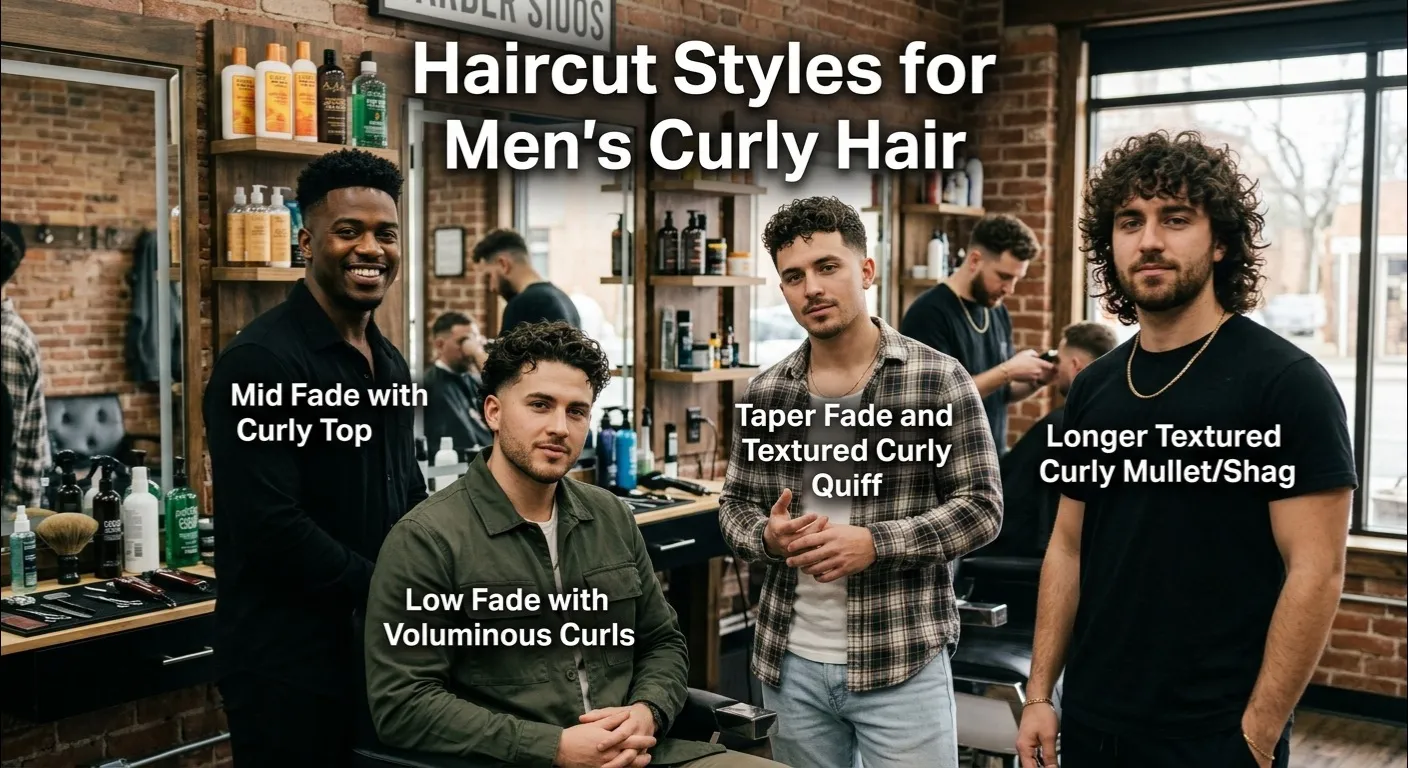
Here is quick answer for “Haircut Styles for Men’s Curly Hair”.
Quick Answer: Not all curls are equal , the cut that looks incredible on your friend may completely backfire on your texture. Men with Type 3 loose ringlets thrive with a Low Taper Fade or Modern Mullet, which adds clean structure without sacrificing natural coil spring.
Identifying Your Curl Type Matrix (2C to 4C)

Most style guides skip straight to the cut list without addressing the foundational question: which curl type are you working with? The answer changes everything , from the scissors your barber uses, to the products you apply, to the shape your stylist builds.
Type 2C to 3A: Wavy Curly Hybrid Foundations


If your strands form loose ‘S’ shapes rather than tight corkscrews, you fall into this hybrid wavy curly zone. These patterns struggle with horizontal volume and look flat if cut too long on the crown without strategic layering. Cuts here use internal layers and perimeter texturizing to coax strands into clumping naturally together.
Type 3B to 3C: True Curly Ringlets and Corkscrews


This covers classic, springy ringlets that coil tightly , loops that absorb humidity heavily throughout the day. These patterns are highly prone to frizz that builds from lunch hour onward, especially in coastal and Southern climates. Weight distribution along the sides and back is the central technical consideration when planning any cut for this matrix.
Type 4A to 4C: Coily, Kinky, and Afro Textured Patterns


Type 4 hair features dense, ultra tight ‘Z’ or micro corkscrew patterns that grow outward with magnificent natural volume. This curl profile experiences the highest shrinkage rate ,often losing up to 70% of apparent length once fully dry. Protecting the delicate moisture barrier is paramount; brittle, dehydrated coils will not hold any silhouette cleanly.
The Definitive 2026 Curly Haircut Styles Matrix
Below, we break each major style cluster into individual variants with the specific technical reasons each cut works on curly textures.
Cluster A (Low Taper Fade)

The most requested corporate friendly option for curly hair across major US cities today. By shaving only the lower perimeter of the hairline, it retains incredible weight and texture density across the entire crown. It is the safest and most versatile entry point for anyone exploring structured haircut styles for men’s curly hair.
Cluster A (Drop Fade)

For a more aggressive, contemporary edge, the Drop Fade curves dramatically behind the ear to isolate curl volume on top. This silhouette is particularly effective on Type 3B to 4A patterns, amplifying the natural spring and density of the coils. It photographs exceptionally well and has become a signature of modern urban barbering culture globally.
Cluster A (High Fade)

The High Fade pushes the transition point up to the temples, creating maximum contrast and a bold sculptural result. This works best for men with strong crown density who want their curls to command full visual attention from the top down. It requires maintenance visits every two to three weeks to keep the blend sharp as the sides grow in.
Cluster B (Modern Curly Mullet)

The Modern Mullet , reinterpreted for curly textures , uses layered construction and structured perimeter fades at the temples. Unlike flat 1980s mullets, the curly version lets natural coil movement dictate the shape from crown to nape. It pairs especially well with Type 3A to 3C ringlets, where the length contrast creates a stunning dimensional effect.
Cluster B (Wolf Cut)

The Wolf Cut blends shaggy 1970s layering with the volume demands of modern curly texture into a relaxed but intentional shape. Layers are cut at multiple lengths so curls stack on each other and create visible depth rather than merging into one mass. This is one of the few cuts that actually looks better on curly hair than on straight hair , the curl movement gives layers genuine life.
Cluster B (Broccoli Cut)

Still popular on social media, the Broccoli Cut is a rounded, mushroom shaped silhouette with tight faded sides. It works cleanly on Type 3C and some 4A textures but has limited shape variation and can look generic without customization. It is a solid starting reference, but worth evolving into a more personalized variant once you understand your texture.
Looking for decade specific inspiration? These classic men’s nineties haircuts offer curl friendly silhouettes that still translate cleanly into modern cuts.
Cluster C (Textured Crew Cut)

A close clipper crop on the sides transitions into one to two inches on top , displaying curl definition without any product layering. This delivers a sub two minute morning styling experience without sacrificing your natural curl identity. It is a particularly strong option for Type 4A and 4B textures, where dense coils create visual texture even at short lengths.
Cluster C (Edgar Cut)

The Edgar features a blunt, horizontal fringe line across the forehead combined with a high fade on the sides. The flat top line requires regular trimming to maintain its precision , typically every two to three weeks. Overall structure is low maintenance between visits since the sides stay clean without daily product application.
Cluster C (Buzz Cut)

The ultimate reset , a tapered buzz removes all styling friction entirely for men dealing with damage or extreme dryness. A slight skin fade at the temples prevents it from looking shapeless and keeps the overall look intentional. Many Type 4 men find the uniform cut reveals the beautiful natural pattern density of their coils at close range.
Frizz Strategy by US Region

Curly hair reacts dynamically to the atmospheric conditions of wherever you live , what holds in Denver may fall apart in Miami within thirty minutes.
High Humidity Defence (Texas, Florida and East Coast)

Sustained humidity forces the hair shaft to absorb water vapor and swell at the cuticle level, breaking apart styled ringlets. The solution must be applied before exposure , anti humectant polymer creams seal the cuticle surface before moisture penetrates. High hold gels lock curl groupings in place from the moment you step outside until your next wash session.
Arid and Alpine Moisture Preservation (Colorado, Arizona and West)

Dry climates strip internal moisture from the cortex, leaving curls brittle, stiff, and structurally compromised throughout the day. Without consistent hydration, curl ends split rapidly and coils tighten unevenly, ruining the lines of any taper or fade. A rich leave in conditioner sealed with argan or jojoba oil daily is essential to maintain elasticity and prevent breakage.
The Barber Blueprint: Scripted Prompts for Your Next Visit
Most curly hair disasters stem not from barber incompetence but from poor communication at the consultation stage.
Requesting Shape Over Length

Never say ‘take two inches off’ without structural context , this almost always results in a shapeless, poofed out outcome. Instead, describe the outer perimeter shape you want: round, rectangular, or oval, and let the length follow from that geometry. A skilled barber working on curly hair builds the shape first and arrives at the length as a consequence.
Mandating the Dry Cut Check

Water stretches the hair fiber significantly, hiding your natural shrinkage rate and creating the illusion of extra length. A dry cut check , revisiting the perimeter after the hair fully contracts , guarantees what you see in the chair is what you take home. Without this step, a wet cut can end up two full inches shorter than intended once the curls fully spring back.
Banning Thinning Shears

Thinning shears slice through curl groupings mid-shaft, creating invisible patches of short strands that spring into permanent frizz. Once this internal damage exists, no product can repair it , you simply have to wait for the sections to grow out entirely. Always insist on traditional shears with precision point-cutting to safely lighten any areas that feel too heavy or dense.
The Scientific Styling Protocol: Step by Step
Step 1: The Sulfate Free Hydration Foundation

Standard drugstore shampoos strip the scalp’s natural sebum oils , the oils curls depend on for lubrication and cuticle smoothing. Always use a sulfate free hydrating cleanser followed immediately by a moisture rich conditioner applied generously. Detangle gently from ends upward with your fingers while the conditioner is still saturating the hair before rinsing.
Step 2: The Damp State Product Application Rule

Never apply styling creams or hold gels to bone dry curly hair , product must go in at roughly 80% dampness. At this stage the strands are still clumped by residual water weight, making even product distribution far more effective. Rake the product through each section, then squeeze each curl cluster gently upward to reinforce the natural grouping pattern.
Step 3: Diffuser Mechanics vs. Strategic Air Drying

A wide bowl diffuser on low heat disperses airflow evenly, drying curls from the inside out without disturbing their shape. If air drying, resist every urge to touch or shake the hair until it has reached complete dryness , any manipulation introduces frizz. Both methods work equally well; the choice comes down to how much time you have and the level of definition you want.
Product to Texture Optimization Matrix

| Product Type | Best Curl Type | Primary Purpose | Finish Level |
| Styling Cream | Type 3A , 3C | Moisture & Bounce | Natural Satin |
| Sea Salt Spray | Type 2C Wavy | Volume & Definition | Matte Texture |
| Heavy Hold Gel | Type 4A , 4C | Shape & Anti Frizz | High Shine |
| Texture Clay | Short Fades / Crops | Matte Separation | Ultra Matte |
FAQs About Haircut Styles for Men’s Curly Hair.
Why do my curls look great wet but frizzy when dry?
Water temporarily binds strands into clean groupings , once it evaporates, the cuticles separate outward into frizz. Specifically, a leave in conditioner or light hold cream applied while damp seals the surface just before the drying process begins.
How do I stop my curly hair from expanding horizontally?
The ‘triangle head effect’ happens when hair is cut to one uniform length with no internal vertical layering. Consequently, incorporating internal layers or a mid drop fade redirects that visual weight upward, thereby creating a balanced oval silhouette instead.
How often should men with curly hair get a haircut?
High contrast skin fades typically need a shape up every two to three weeks to keep the blend looking intentional. Longer lived in cuts like a Wolf Cut or Modern Mullet can stretch to five or six weeks without losing their core shape.
For retro inspired cut ideas that adapt beautifully to modern curly textures, explore this archive of men’s nineties haircuts , many templates remain technically relevant for textured hair today.
