Guide to Guard Lengths, Scalp Health, and Matching Your Face Shape
Here is quick answer for Buzz Cut For Men.
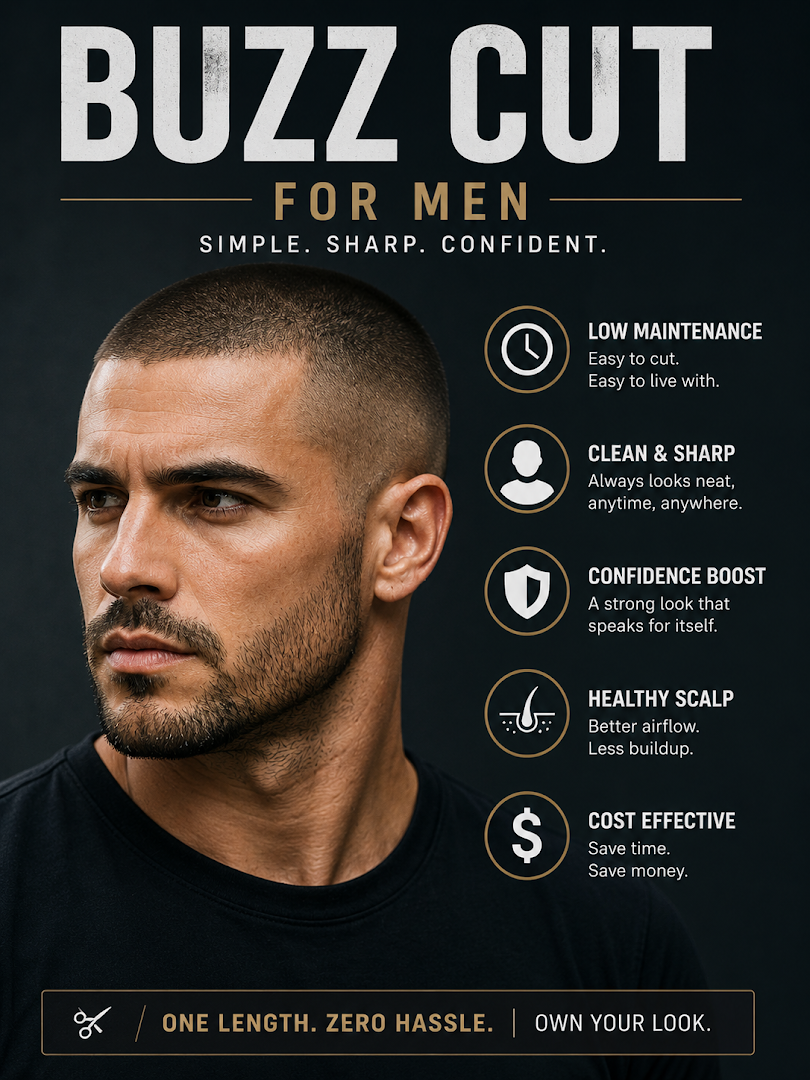
QUICK ANSWER: A buzz cut is a short haircut made with hair clippers, usually between guard #0 and #5. It is fast, neat, and easy to manage. This guide covers every style, guard length, scalp care tip, head shape consideration, and clipper mechanics men need to make an informed decision.
Introduction
A buzz cut is one of the most enduring haircuts in men’s grooming history, and for good reason. It projects confidence, eliminates decision fatigue at the mirror every morning, and adapts to virtually every face shape when chosen strategically.
But the gap between a buzz cut that looks deliberate and one that simply looks lazy comes down to details most guides never address , guard selection relative to hair density, the mechanical differences in the clippers doing the work, and the anatomical realities of your scalp underneath. This guide covers all of it.
Section 1: Demystifying the Buzz Cut (The Technical Core)


What Is a True Buzz Cut?


A true buzz cut is executed exclusively with electric clippers , never scissors. The result is an even, uniform length across the entire head, defined by the guard number attached to the blade. Unlike a taper or a fade, the classic buzz maintains consistent density from crown to nape. What changes between styles is that guard number and how it interacts with your specific hair texture, density, and scalp colour.
Explore more on The Ultimate Layered Bob Haircut Guide.
The Clipper Guard Matrix: Guard #0 to #5+ Lengths Explained


| Guard Number | Hair Length Left Behind | Scalp Visibility |
| #0 | Bald / skin level | Complete, no hair cover |
| #1 | 1/8 inch (approx. 3mm) | High , scalp clearly visible |
| #2 | 1/4 inch (approx. 6mm) | Moderate on thin hair, low on thick |
| #3 | 3/8 inch (approx. 10mm) | Low , scalp largely hidden |
| #4 | 1/2 inch (approx. 13mm) | Minimal , good coverage for most |
| #5+ | 5/8 inch or more (16mm+) | Virtually none |
Hair Density vs. Guard Numbers: How Much Scalp Will Show?


Guard numbers are not universal outputs,they interact with hair density in ways that significantly alter the final look. Thick hair creates a visual buffer that hides scalp even at low guard settings. Fine or thinning hair offers far less coverage at the same length. The practical rule: if your hair is fine, add one guard number to your intended choice. A #2 result on thick hair often looks equivalent to a #3 on finer strands.
Clipper Motor Types: What Every DIY Reader Needs to Know


The tool matters as much as the guard. Consumer grade buzz cut clippers fall into three mechanical categories, each with real implications for performance and longevity.
Magnetic Motors
Magnetic motors use electromagnetic force to drive the blade at high speeds , typically 7,000 to 14,000 strokes per minute. They’re lightweight and quiet, which makes them popular in consumer clippers. The downside is torque: magnetic motors lose speed and cutting power against thick or dense hair, causing pulling and an uneven finish. Ideal for fine to medium hair and touch up trims.
Pivot Motors
Pivot motors run at slower speeds (around 4,000 to 7,000 strokes per minute) but generate significantly more torque. They push through thick, coarse, or curly hair without hesitation. Most professional barbershop grade clippers use pivot motors.
For those frequently cutting thick, coarse, or wiry hair at home, a pivot motor clipper is the superior choice; these machines offer significantly greater longevity than magnetic models and deliver a smoother, more consistent cut.
Rotary Motors
Rotary motors use a rotating mechanism to drive the blade and are engineered for maximum sustained power. They handle the widest range of hair types without adjustment and are the most durable of the three. The trade off is weight and cost. Rotary clippers are typically found in high end professional units. For most home users, a quality pivot motor clipper hits the optimal balance of performance and price.
Section 2: Seven Timeless and Contemporary Buzz Cut


Styles1. The Induction Cut (#0 or #1 Guard)


The shortest option in the spectrum, near bald, sharp, and uncompromising. Military recruits get this on day one for a reason: it eliminates individuality and maintenance simultaneously. At #0, you’re cutting to skin. At #1, a faint shadow of hair softens the effect slightly. Strong jaw and skull structure become the visual focus, so this works best on men confident in their head shape.
2. The Burr Cut (Guard Sizes #1 to #3)


Occupying the sweet spot between a traditional induction cut and a standard buzz, the burr cut provides a clean, understated aesthetic using clipper guard lengths ranging from one to three. At #2 or #3, the hair develops a soft, even texture that reads as intentional rather than military issue. It’s forgiving on irregular head shapes because the slight length diffuses light differently than a completely shaved head, masking minor bumps and asymmetry.
3. The Butch Cut (Guard Lengths #3 or #4)


The butch cut uses guard #3 or #4 to leave enough hair for visible texture without crossing into “actual styling” territory. Fuller on top than a burr cut, it suits men who want the ease of a buzz without the severity of the induction look. Round and square faces tend to carry this well.
4. The Brush/Crew Cut Buzz (#4, #5, or Longer)


Guards #4 and above retain enough length on top that the hair stands slightly upright , the classic “bristles” look of military crew cuts. At this length, a small amount of product is possible and daily direction can be shaped. It bridges the territory between a buzz and a traditional short haircut.
5. The High and Tight Military Buzz


The High and Tight maintains a sharp contrast between extremely close cropped sides and back ,often #0 or #1 ,and a slightly longer top section. The abrupt transition creates a structured, disciplined silhouette. It requires a steady hand or a skilled barber to execute cleanly, as the line between the two lengths needs to be precise.
6. The Skin Fade Buzz Cut (Low, Mid, and High Fade Variations)


A skin fade blends the hair gradually from bare skin upward through increasing lengths. Low fades begin just above the ear and produce a conservative, professional result. Mid fades hit around the temple area for a bolder contrast. High fades start near the crown and create the most dramatic transition. Each fade height fundamentally changes the proportions of the cut and interacts differently with face shape,low fades add visual width, high fades add visual height.
7. Textured Buzz Cut with Geometric Razor Designs


The most personalized option on this list. A barber with a straight razor or detail trimmer adds lines, curves, or patterns, typically worked into the fade or sides. Best results come from darker, thicker hair that creates clear contrast against bare skin. The designs range from simple temple lines to intricate geometric shapes.
Section 3: Managing Atypical Head Shapes


Most buzz cut guides stop at face shape. That’s a significant omission, because your skull’s topology under the hair is just as consequential. Short cuts expose the head’s three dimensional form in a way longer hair conceals, and certain anatomical features become much more visible.
Flat Crowns


A flat or plateau shaped crown ,where the top of the head lacks the gentle dome typical of most skulls, can look stark at very short lengths. A uniform #1 or #2 buzz emphasises the flat plane. The fix is strategic: a slightly longer guard on the crown (#3 or #4) while keeping sides shorter creates the illusion of dome curvature. The light catches longer hair differently and visually rounds the top.
Asymmetrical Bumps and Ridges


Occipital bones (the ridge at the back of the skull), asymmetrical side bumps, or post surgical irregularities become visible at short lengths. A very low fade or skin level cut will highlight these features. Two effective strategies exist: increase the overall guard length to #3 or #4, where hair cover diffuses the appearance of ridges; or embrace a skin fade that draws visual attention to the sides rather than the back and crown, redirecting where the eye travels.
Narrow or Elongated Skull Shapes


A narrow skull that tapers toward the crown can make a uniform buzz look like an inverted triangle from behind. A low fade with slightly more weight kept through the sides adds perceived width to a narrow skull profile. Avoid high fades entirely on this head shape, they amplify the taper and make the head look even narrower at the top.
Section 4: The Ultimate Oblong Face Haircut Matrix


Why Oblong Face Shapes Need a Strategic Approach


Individuals with oblong face shapes possess a length that exceeds their width. The instinct to add personality via height, spikes, quiffs, high top fades, is exactly wrong for this shape. Every inch added on top stretches the visible face length further. The correct counter strategy is adding perceived width: side volume, low fades that keep hair fuller through the temporal regions, and beards that widen the jaw line.
Haircut 1: The Low Taper Fade Buzz Cut


A low taper fade preserves fullness along the sides while gradually reducing length only near the ear and nape. The effect pulls the viewer’s eye laterally rather than vertically, exactly what an oblong face requires. It is the most universally safe choice for this face shape and works across all hair densities.
Haircut 2: The Texturized French Crop Buzz with Forward Fringe


A short buzz on top paired with a defined, forward swept fringe that sits across the forehead. The fringe interrupts the vertical line of the face and visually shortens the forehead’s perceived length. Keep the fringe horizontal and short, no longer than mid forehead , to avoid the fringe itself becoming a vertical feature.
Haircut 3: The Classic Crew Cut Buzz with Soft Scissor Cut Sides


To achieve a gentler profile along the sides, combine a clipper cut top with scissor cut transitions. The scissors allow the barber to build width through the parietal region (the upper side of the head) without the harsh boundaries a standard fade creates. Clean, professional, and appropriate for conservative environments.
Haircut 4: The Butch Cut Paired with a Dense, Boxed Beard


A full, squared off beard adds jaw width that the haircut alone cannot provide. The boxed shape is critical, rounded or tapered beards create vertical lines. A wide, dense boxed beard at chin level is one of the most effective structural corrections for an oblong face, regardless of the exact buzz guard used on top.
Haircut 5: The Ivy League Buzz with Temple Taper


A modest length on top ,around #4 to #5, tapered cleanly at the temples gives a polished, structured result. The temple taper keeps the sides tidy without removing the width that wider side coverage provides. Suits professional and formal contexts comfortably.
Haircut 6: The Short Messy Buzz (Avoiding Top Volume)


When in doubt, keep the top short and lightly textured. The key word is textured, not tall, a small amount of matte paste applied to a #3 or #4 top creates movement without adding height. To prevent the hair from appearing flat or having unruly root lift, avoid using styling gels or pomades.
Haircut 7: The Low Skin Fade Burr Cut with Crisp Line Up


A tight line up across the forehead and temple, combined with a low skin fade, frames the face with sharp horizontal geometry. Crisp edges draw the eye across rather than up. The barber’s technique at the line up matters significantly here, a slight arch versus a perfectly horizontal line alters the face shape perception.
Haircuts to Avoid: High Top Fades & Vertical Spikes

High top fades and any style that adds vertical height above the crown are counterproductive on oblong faces. The additional height increases perceived face length with no compensating width benefit. The same applies to tall spike styling products applied to a butch or crew cut , even a small amount of upward direction on longer tops creates a lengthening effect.
Section 5: The Camouflage Strategy , Buzz Cuts for Thinning Hair


Receding Hairlines (M Shape)


An M shaped recession exposes the temples and pushes the hairline back at the corners. Longer styles attempt to compensate by combing hair forward, often unsuccessfully. A uniform low buzz at #1 or #2 removes the comparison point entirely: when all hair is the same short length, there is no obvious boundary between “hair area” and “bald area.” The recession becomes invisible not because it’s hidden but because it’s no longer the highest contrast feature.
Crown Thinning vs. Uniform Buzzing


Diffuse thinning at the crown appears more pronounced under longer hair because the scalp underneath creates a visible parting or thinning zone. Buzzing uniformly short eliminates this contrast. Barbers commonly suggest going to a #1 or #2 throughout rather than keeping any area longer, since longer remaining hair tends to lie flat over the thinning area and draw attention rather than masking it.
Section 6: The Naked Scalp Guide , Health & Maintenance


Post Buzz Shock: Managing Sudden Scalp Dryness, Acne & Folliculitis


The first 48 to 72 hours after a very short cut often produce an adjustment reaction. Scalp skin that has been under hair cover encounters air, friction from pillowcases and headrests, and direct product exposure for the first time in months or years. Mild dryness and small follicular bumps (folliculitis) are common. Gentle washing with a sulphate free shampoo, a fragrance free light moisturiser, and avoiding heavy styling products for the first week resolve most cases quickly.
Scalp SPF: Why Your Newly Exposed Skin Needs Sun Protection


Scalp skin that has been under cover is among the least UV adapted skin on the body. When using a #1 guard or shorter, the scalp receives essentially the same level of UV exposure as entirely bare skin.
A broad spectrum SPF 30 or higher applied before outdoor exposure is not optional, it prevents both acute sunburn (which is painful on the scalp) and the long term cumulative UV damage that raises skin cancer risk on an already high exposure area of the body.
Trim Frequency: The 7 Day Rule


A buzz cut at #1 or #2 grows visibly within a week. To keep a look polished, stylists recommend a seven day turnaround for the shortest hair lengths; for styles involving a #3 guard or longer, which usually start to look grown out after ten days ,a visit every ten to fourteen days is ideal. Line up touch ups can be done at home with a detail trimmer between barbershop visits.
Frequently Asked Questions
Q1. How long does it take for a buzz cut to grow out completely?
Most men see a noticeable length at four to six weeks post cut. Full regrowth to a length that allows traditional scissor styling takes three to four months depending on individual growth rates, which average half an inch per month.
Q2. Does buzzing the hair make it grow back thicker?
No. Hair thickness and growth speed are determined by the follicle, which is entirely below the skin and unaffected by surface cutting. Hair feels coarser immediately after a buzz because the blunt cross section of the cut end feels different to the touch than a naturally tapered tip, but the actual strand diameter is unchanged.
Q3. How do I get an even cut at home without a barber?
Start at the highest guard you’re considering and work down incrementally. Always cut against the direction of hair growth for even coverage. Use a handheld mirror and a bathroom mirror together to check the back and crown. Good lighting is more important than most DIY guides acknowledge.
Q4. What are the best products to maintain scalp health after a buzz cut?
A sulphate free gentle shampoo, a fragrance free lightweight moisturizer, and a broad spectrum SPF 30 or higher form the essential kit. A mild exfoliating scalp scrub used once per week prevents dead skin buildup, which is more visible on a closely cropped head. Men prone to folliculitis should incorporate a salicylic acid shampoo one to two times per week during the initial adjustment period.
Conclusion
A buzz cut is simple in execution but nuanced in selection. The difference between a cut that looks deliberate and one that looks accidental comes down to guard choice matched to your hair density, awareness of your skull’s actual topology under the hair, a clipper motor suited to your hair type, and a face shape aware strategy for proportions. Pair those choices with consistent scalp maintenance and a realistic timeline for the growing out phase, and the result is a cut that projects confidence precisely because it looks like an informed decision, not a default.
